How does nicotine nasal spray calm cravings within minutes? This article provides a comprehensive analysis of this rapid smoking cessation tool, from neuroanatomical principles to practical operation.
Rapidly Calming the "Craving Storm": A Practical User Manual and Deep Scientific Analysis of Nicotine Nasal Spray
In the long journey of quitting smoking, what often feels the most helpless, even despairing, is not the months-long battle of willpower, but the sudden, tsunami-like "craving peak" that sweeps through your entire body.
I have conducted in-depth interviews with dozens of heavy smokers trying to quit, and their descriptions are almost identical: in an instant, a calm brain is suddenly struck by a primal, hungry electrical current. You feel your fingertips tremble slightly, your heartbeat accelerates for no reason, your vision seems to narrow, and a physiological, urgent anxiety arises — it feels like walking in a dry desert for days, suddenly seeing a clear spring in the distance, but being told you can only gaze at it with longing. This "craving storm" usually peaks within minutes, and if you cannot calm it in a very short time, your brain will take over your decision-making system, leading you back to that cigarette after your willpower collapses.
For heavy smokers accustomed to obtaining dopamine feedback quickly through smoking, traditional nicotine patches can sometimes seem too "tepid." The patch penetrates through the skin layer by layer, providing a slow, steady baseline concentration. It's like a bass note playing in the background music, capable of suppressing most background noise, but when facing sudden, high-decibel craving impacts, its reaction speed clearly cannot keep up with the physiological crisis caused by the sudden drop in neurotransmitters.
This leads to a more "tactical" tool — Nicotine Nasal Spray. It is not meant to replace the patch, but to become your most acute and rapid "emergency response force" in dealing with sudden impulses during the quitting process.
Rapid Penetration: Why is the Nasal Cavity the Best "Shortcut"?
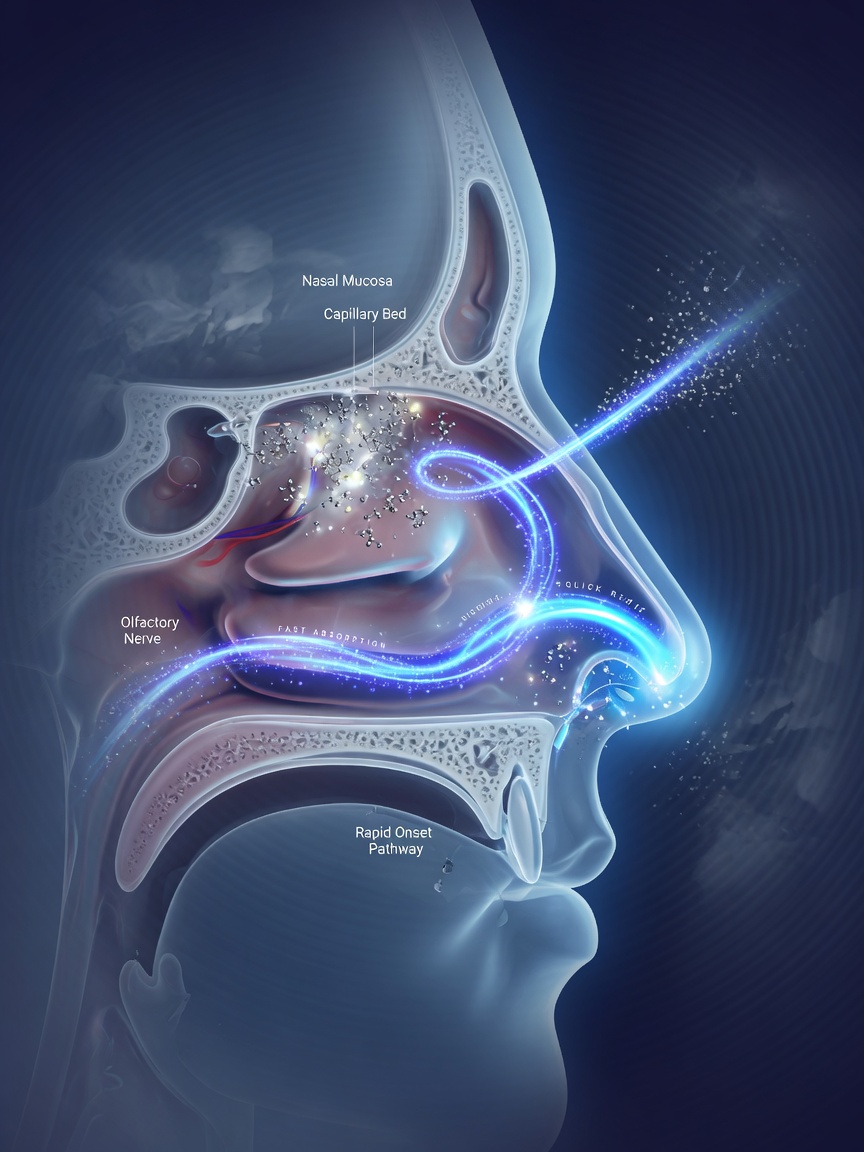
To understand why nasal spray is so effective, we must delve into the microscopic world of neuroanatomy and mucosal absorption.
When we engage in traditional smoking, nicotine enters the blood through the pulmonary capillaries, bypasses the liver's first-pass metabolism, and reaches the brain within seconds. Gum or patches, on the other hand, either require absorption through the digestive tract or need to penetrate the thick stratum corneum of the skin, which is a significant disadvantage in terms of time.
The nasal mucosa plays a unique role in human physiology. It is not only the first line of defense for breathing but also a "highway" densely packed with rich microvascular networks and sensory nerve endings. The nasal mucosa is very thin and has extremely high permeability.
From a biochemical perspective, nicotine molecules can achieve "transmucosal direct absorption" through intercellular spaces or cell transport on the nasal mucosa. This means the drug, without undergoing complex circulatory processes, can directly enter the circulatory system with high efficiency and quickly cross the blood-brain barrier.
Furthermore, the structural proximity of the nasal cavity to the brain's olfactory pathway also facilitates rapid drug delivery. Nicotine absorbed through the nasal mucosa can more directly affect acetylcholine receptors in the central nervous system. Clinical data indicate that nicotine nasal spray typically reaches peak plasma concentration within 5 to 10 minutes after administration. This "second-level response" capability allows it to precisely intervene during the "golden window" of a craving storm, calming the "hunger" of acetylcholine receptors in the nervous system before your willpower completely collapses.
Avoiding Pitfalls: A Precision "Spray Protocol" Down to the Action
In practical operation, I have found that many users, although they have purchased nasal spray, either absorb the drug insufficiently or cause unnecessary mucosal damage due to easily overlooked incorrect movements. This often stems from an intuitive mistake: instinctively taking a deep breath or sniffing forcefully while spraying.
If you inhale forcefully while spraying, you will find that the drug does not stay on the nasal mucosa but flows directly down the throat and even into the stomach. This not only greatly reduces the absorption efficiency in the brain but also gives you an uncomfortable nausea similar to swallowing chemicals.
To achieve the best absorption effect, I have summarized a set of "Spray Protocols" that must be strictly followed. This is not just a technical requirement but also a form of psychological preparation:
- Priming: This is the first step most people overlook. If you are using it for the first time, or if it has been more than 24 hours since your last use, be sure to cover the nozzle with a tissue, press the pump 6-8 times until a fine, even mist is sprayed. This ensures the dosage for your next use is accurate and stable.
- Posture Adjustment: Do not stand upright; instead, tilt your head slightly backward. This angle allows the spray to cover the mucosal area at the back of the nasal cavity more evenly (especially the microvessel-dense area near the turbinates), rather than just spraying the tip of the nose.
- Breath Switching (Core Detail): This is a crucial action. At the moment you press the nozzle, breathe through your mouth. Do not inhale through your nose. If you try to "capture" the drug with your nose, you are actually forcibly pushing the drug away from the absorption site.
- Precise Spraying: Gently insert the nozzle into one nostril to a comfortable depth. Press firmly and quickly once, then repeat for the other nostril. Remember, the standard dose is typically one spray per nostril.
- Stillness and Rest: After spraying, maintain this posture for at least 2 to 3 minutes. Do not blow your nose immediately. At this time, you should breathe gently and rhythmically through your mouth, allowing the drug to settle naturally on the mucosa.
By following this protocol, you will find the absorption sensation becomes smoother, and that feeling of "the drug slowly dispersing within the nasal cavity" is the signal that it is truly taking effect.
Tactical Combination: The "Dual-Track Strategy" of Patch and Spray
In the long-term battle of quitting smoking, fighting alone is often unsustainable. The most successful cases of smoking cessation usually adopt a "steady-state + dynamic" combination strategy.
We can think of the nicotine patch as your "defensive position." The patch provides an all-day, low-fluctuation baseline level of nicotine through transdermal absorption. It is like background music, responsible for suppressing the persistent withdrawal symptoms lurking in your subconscious, allowing you to maintain a relatively stable psychological state.
The nasal spray, on the other hand, is your "special forces." When you feel the "defense line" maintained by the patch is about to collapse during certain high-pressure moments — such as during a stressful meeting break or in the quiet solitude of late night — use the nasal spray immediately for reinforcement.
This "patch maintains the baseline, spray handles the peaks" model can smooth out the nicotine concentration curve in the blood to the greatest extent. It avoids the collapse of willpower caused by concentrations being too low, and also prevents the drastic fluctuations in concentration that might occur from relying solely on the spray. This combination essentially uses physiological means to buy precious time for your psychological rebuilding.
Dealing with the "Pepper Taste": A Practical Mindset for Side Effects
Every powerful tool has its price. For nicotine nasal spray, the most common feedback is a strong, "pepper-like" burning or irritating sensation in the nasal cavity and throat.
This feeling is most noticeable during the first week of use. From a physiological mechanism perspective, it is a direct chemical stimulation of the trigeminal nerve endings distributed on the nasal mucosa as nicotine molecules rapidly penetrate the mucosa.
Faced with this side effect, I suggest adopting two mindsets:
First, Expectation Management. Before your first use, clearly tell yourself: this burning sensation is a physical signal that the drug is "rapidly penetrating." When you no longer see this feeling as "pain" but as "effectiveness," your anxiety will significantly decrease.
Second, Rhythm Adjustment. If the irritation feels unbearable, you can try slightly adjusting the insertion depth of the nozzle, or relieve local pressure through slow mouth breathing after spraying. As long as this irritation gradually lessens after the first week, it usually means your nasal mucosa is undergoing a normal physiological adaptation process.
But remember, if this irritation evolves into persistent nasal ulcers, bleeding, or severe difficulty breathing, be sure to stop using it immediately and seek professional medical help.
Risk Defense: Who Needs to Stay Vigilant?
Although the nasal spray is a powerful tool, it is by no means a universal remedy for everyone. Due to the specificity of its absorption pathway, it may pose additional risks for certain groups.
If you suffer from chronic rhinitis, sinusitis, or severe asthma, the nasal spray may exacerbate your respiratory reactivity. Changes in nicotine concentration on the local mucosa can trigger airway spasms or fluctuations in mucosal inflammation.
Furthermore, for individuals with a history of heart disease (especially those who have recently experienced myocardial infarction or unstable angina), extreme caution is necessary. Nicotine's activation of the sympathetic nervous system is significant; it can cause increased heart rate or blood pressure fluctuations, which are risks not to be ignored for individuals with fragile hearts.
For pregnant and breastfeeding women, the current medical consensus is that since nicotine can directly enter the fetus or infant through the placenta and breast milk, NRT use must be under strict medical supervision, and behavioral intervention is usually recommended as the first priority.
Towards the Finish Line: Don't Stop at the Peak
Quitting smoking is not a process of "activating a tool," but a process of "gradual withdrawal."
A common mistake is: when you feel very comfortable using the nasal spray and your cravings are perfectly suppressed, you get the illusion that "I'm already cured," and suddenly stop all auxiliary means. This behavior can easily lead to a vengeful rebound of withdrawal symptoms.
The correct approach is to establish a stepwise reduction plan. As your control over cravings strengthens, you should systematically reduce the frequency of spray use. For example, transition from coping with sudden impulses, to using it only under extreme stress, and finally, under a doctor's guidance, withdraw completely.
The process of quitting smoking is essentially a process of rebuilding the brain's reward system. Nicotine nasal spray provides you with a safe cushion, allowing you to smoothly navigate through the darkest period of neural reconstruction without tobacco.
When you can finally face stress calmly without needing any chemical substance to maintain emotional stability, you have truly won this war.
*This article is intended to provide scientific information and does not constitute medical diagnosis or treatment advice. Before using any nicotine replacement therapy, please consult your doctor or a qualified medical professional.*
Nicotine Patch (Defensive Position)
Transdermal absorption, maintains stable low concentration all day; slow response, suitable for suppressing baseline withdrawal symptoms
Nicotine Nasal Spray (Special Forces)
Rapid mucosal absorption, peaks in 5-10 minutes; fast response, ideal for sudden craving surges
⚠ Note: All data in this article are from clinical studies; individual responses may vary.